At a ceremony held in Đelekovec, Tomislav Golubić, County Prefect of Koprivnica-Križevci County, together with the mayors of ten municipalities along the Drava River — Drnje, Ferdinandovac, Gola, Hlebine, Legrad, Molve, Novo Virje, Peteranec, Podravske Sesvete and Đelekovec — signed the Declaration on Sand Martin Protection along the Drava River in Koprivnica-Križevci County.
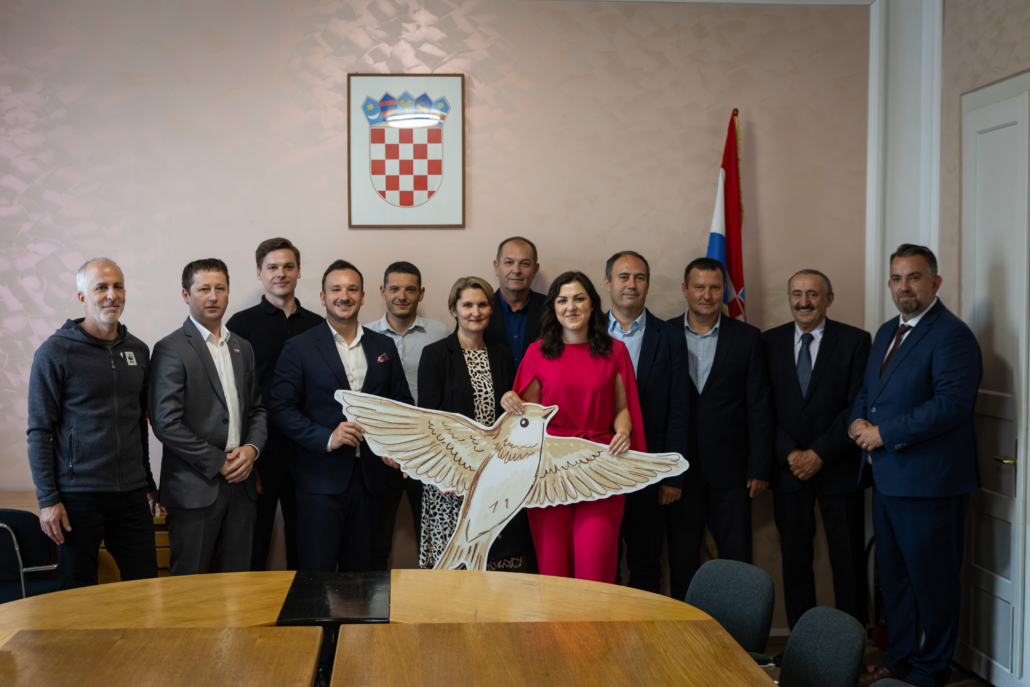 By signing the Declaration, the signatories express their support for the active protection and restoration of the natural habitats of the sand martin (Riparia riparia) — a strictly protected migratory bird whose colonies in the steep sandy banks of the Drava are one of the most reliable indicators of a healthy river ecosystem. Aware that bank reinforcement and loss of suitable nesting sites have led to population declines, the signatories commit to protecting existing colonies, raising awareness, and strengthening cooperation along the Drava and within the UNESCO Five-Country Biosphere Reserve Mura–Drava–Danube.
From a Record Colony to a Regional Commitment
The initiative was sparked by the remarkable results achieved at the steep riverbank of Libanovec in the Municipality of Đelekovec — the largest sand martin colony on the Croatian stretch of the Drava. In favourable years, when river levels are higher, the site supports up to 1,800 nesting pairs, even as the national population continues to decline. The success is no accident: under the DRAVA LIFE project, rather than reinforcing the bank, natural erosion processes were deliberately allowed to continue. An innovative land-use agreement was reached with local farmers, accepting a gradual reduction of arable land in exchange for lower lease costs. This model — aligning conservation and agricultural interests without conflict — is now set to serve as a template for all municipalities along the Drava. In recognition of these efforts, the Municipality of Đelekovec was officially designated Croatia’s first Sand Martin Village in 2024, an initiative developed jointly by the Municipality, family farm OPG Puhar, WWF Austria, Croatian Waters, the Public Institution for Nature Protection of Koprivnica-Križevci County and Green Osijek. A special role in spreading the sand martin story belongs to the Vêndi Association, which for years has been building bridges between nature conservation and art through painting workshops, literary gatherings and various cultural events. On 14 May, a sculpture of the sand martin by artist Dragutin Ciglar was unveiled in Đelekovec, becoming a physical symbol of the entire community’s commitment to nature and the Drava. The initiative is now outgrowing its local roots.

Lara Samošćanec Kiš, Mayor of the Municipality of Đelekovec, said: “Đelekovec showed that a small community can take responsibility for the nature that surrounds it. We are no longer alone — the other nine mayors and the County Prefect have stood beside us, and together we have said: the Drava and everything that lives along it is our shared responsibility. This Declaration is not just a piece of paper; it is a promise to the river and to all the generations that will come after us.”
Arno Mohl of WWF Austria underlined the symbolic weight of this step: “The sand martin may be a small bird, but it has become a powerful symbol of a living Drava River. Today’s declaration shows how nature conservation and local communities can come together around a shared vision. It is an inspiring example for the entire UNESCO Five-Country Biosphere Reserve Mura–Drava–Danube. WWF is committed to continuing to be a reliable partner in turning this shared vision into concrete conservation action in the years ahead.”
Igor Tošić, project coordinator at Croatian Waters, emphasised: “At Libanovec, a small but important step was taken away from the conventional approach of stopping every instance of river erosion immediately. Where there is no direct threat to people, infrastructure or the water regime, a natural steep bank can have great value — here, for one of the most important sand martin colonies on the Drava. The Municipality of Đelekovec and the DRAVA LIFE project partners made an important breakthrough. The support of the County Prefect and ten municipal mayors lends additional weight and provides a solid foundation for discussing similar solutions along the Drava in a timely, expert and community-aware manner.”
Tomislav Golubić, County Prefect, closed the ceremony with words that captured the spirit of the entire initiative: “Koprivnica-Križevci County is proud of the Drava River and everything that lives along it — and we intend to guard it fiercely. But protecting nature cannot be left to environmental organisations or a single municipality. Today, as ten mayors and the County sign this Declaration together, it is clear that the whole of Podravina understands what it has and what it must preserve. Đelekovec opened the way — now we walk it together.”
The Drava River forms a significant part of the UNESCO Five-Country Biosphere Reserve Mura–Drava–Danube (MDD-BR), the largest river protected area in Europe. Its protection and sustainable development are a shared responsibility of the communities through which it flows. By signing this Declaration, Koprivnica-Križevci County and its Drava municipalities make a concrete and visible contribution to preserving this outstanding natural heritage — and position the Podravina region as one that turns ecological responsibility into local policy and identity.
Photo Marko Lorenzo Blaslov
Đelekovec, 14 May 2026 — A sculpture dedicated to the sand martin, created by master ceramicist Dragutin Ciglar Lao, was ceremonially unveiled in the central park of Đelekovec. The sculpture stands as a lasting tribute to the sand martin colony that nests each year in the steep sandy bank of the Drava River at Libanovec, proving year after year that coexistence between people and nature is not merely an ideal, but a reality.
The sand martin (Riparia riparia) is a strictly protected migratory species that travels more than 6,000 kilometres from central Africa to nest in the steep sandy banks of European rivers. Where sand martins nest successfully, rivers retain their natural dynamics — which is precisely what makes the species one of the most reliable indicators of a healthy river ecosystem. The colony at Libanovec is one of the few that has recorded a positive population growth trend over the past decade.
Đelekovec was designated Croatia’s first Sand Martin Village in 2024, a unique recognition that followed years of dedicated collaboration between the local community, family farm OPG Puhar, Croatian Waters and nature conservation organisation WWF Austria. The sculpture is now the physical expression of that status: a public, visible, permanent sign that this part of Podravina cares for its river and the life it sustains.
The event was opened by Lara Samošćanec Kiš, Mayor of the Municipality of Đelekovec, with the words: “When we received the status of Croatia’s first Sand Martin Village in 2024, we knew it wasn’t the end of the story — it was the beginning. This sculpture confirms something we believe: that a small community can take responsibility for the nature that surrounds it and be an example to others. We achieved this status together — residents, the school, the kindergarten and local associations. This sculpture is not just a statue in a park; it is a message that this community knows what it has and values it. That is an identity we are building through our history and passing on to the youngest generation.”
Nikola Cik, Director of the Tourism Board of the “Central Podravina” area, addressed those present: “Central Podravina has one of the most beautiful and healthiest rivers in Europe, but a river alone does not make a tourism story. The story is created when a community is woven into it. Đelekovec has told that story authentically: the sand martin has become a symbol that attracts visitors, educates children, inspires artists and has sparked an entire small ecosystem of creativity. The sculpture in the park now becomes a landmark on the Podravina map that we will show with pride. And I hope it will be an encouragement to other communities along the Drava to find their own story worth preserving.”
Tanja Nikowitz
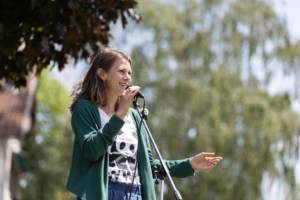
“In the area of the UNESCO Five-Country Biosphere Reserve Mura–Drava–Danube, sand martin populations are declining. Rivers are losing their natural dynamics, banks are being reinforced and birds are losing their nesting sites. Đelekovec is moving in the opposite direction, and that is no coincidence,” said Tanja Nikowitz, nature conservation expert at WWF Austria, adding: “It is the result of a conscious community decision to give the river room. The colony at Libanovec is one of the few in the region that is growing, and that is why Đelekovec is more than an example of good practice: it is proof that recovery is possible! May the sculpture unveiled today be an invitation to other municipalities along the Drava to recognise the value of the river flowing beside them and of healthy, protected nature.”
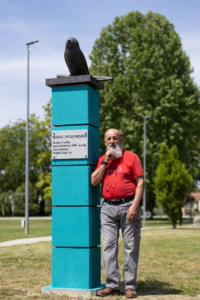
Dragutin Ciglar Lao
“Every sculptor dreams at some point that their work will become part of a place — not just an ornament, but a sign. When I was asked to create a sculpture of the sand martin for Đelekovec, I knew this was exactly that kind of opportunity. This bird is not only beautiful — she is a messenger of the river. The work I created is not mine alone; it belongs to everyone who has protected that bank for years, who has watched the colony grow and who has understood what that means. It means a great deal to me that this sculpture will now remain in Đelekovec — forever,” concluded master ceramicist Dragutin Ciglar Lao, the author of the sculpture, who also created sand martin-themed souvenirs for the Tourism Board of the “Central Podravina” area.
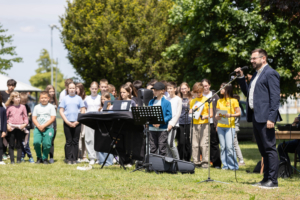
A rich programme was prepared by pupils of the Mihovil Pavlek Miškina Primary School, members of the Vêndi Association for the Preservation of Natural and Cultural Heritage, Culture, Art and the Promotion of Rural Tourism, and Stjepan Žagač on guitar. Following the unveiling, an exhibition of artworks on the theme of sand martins was opened in the school premises — after Đelekovec, the exhibition will tour other towns and municipalities.
Photography: Marko Lorenzo Blaslov
Stara Drava near Varaždin Breathes Again: New Side Channel Opened
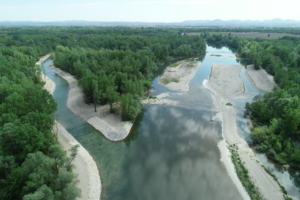
Water is flowing again in the restored “Stara Drava Varaždin (C.2)” side channel — Varaždin has gained its first major flowing side channel and a new natural haven on the edge of the city
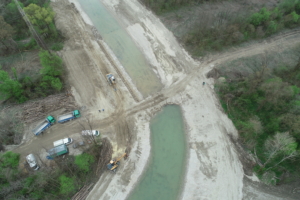
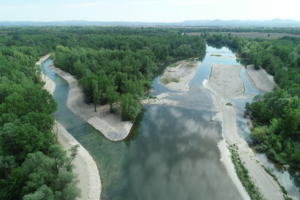
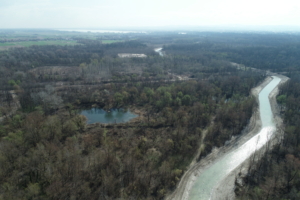
Varaždin, 3 May 2026 — In the area of the City of Varaždin, downstream of “Cirkovečka” and upstream of the tip of the Drava basins, the new side channel “Stara Drava Varaždin (C.2)” has been opened. This is one of the most significant river restoration works on the Drava in recent times, developed through the award-winning and internationally recognised European project “DRAVA LIFE – Integrated River Management”. Varaždin has thereby gained a new natural haven along the Drava, while also improving its flood protection.
The value of the works is approximately 1.7 million euros including VAT, carried out by Hrvatske vode (Croatian Waters) through its regular maintenance programme with financial support from the Recovery and Resilience Facility. This is the result of an almost decade-long process, which included environmental procedures, public consultations, cross-border consultations and cooperation, the preparation of conceptual and detailed designs, and securing financing. Hrvatske vode, the Water Management Department (WMD) for the Mura and Upper Drava, carried out the works despite complex procedures, rising costs and demanding implementation, with the aim of restoring the natural processes of the Drava and creating a safer, more valuable and higher-quality riverside space for Varaždin. The former side channel had for years been cut off from the main river, with water entering mainly from the downstream side and only during higher water levels. Due to the very low flow (biological minimum) in Stara Drava, combined with sediment deposition and vegetation overgrowth, water no longer entered in sufficient quantities to maintain natural dynamics. The consequences were visible across the wider area: groundwater levels declined, riparian forests were affected by succession, the diversity of river habitats decreased, and the main Drava channel was subjected to increasing hydraulic pressure.
Why was vegetation removed?
The removal of vegetation, which was the most visible part of the works, was carried out exclusively along the route of the side channel and in the main Drava channel, opposite the Memorial Cross in the Drava Forest, where vegetation had over decades narrowed the river’s flow cross-section and encroached on former gravel bars and open banks. As Hrvatske vode emphasise, this was not forest exploitation, but rather the restoration of space that historically belonged to the river, alongside a reduction in hydraulic resistance and water levels during high flows, thereby alleviating pressure on the flood defence system, the right bank of the Drava, and existing infrastructure in the Varaždin area. Works being carried out in parallel in the Drava park-forest through the “InterACT Green” project are not part of the “Stara Drava Varaždin (C.2)” works, but a separate project for the improvement and revitalisation of selected parts of the park-forest.
New habitats for protected species
A particular value of this type of river restoration work lies in the creation of new habitats for strictly protected and target river species — birds (little ringed plover, kingfisher, great white egret, black stork), fish (asp) and mammals (otter). Through the shaping of steep sandy-silty banks within the side channel itself and along the left bank of the Drava, favourable conditions have been created for the sand martin (Riparia riparia), a swallow species that through DRAVA LIFE has become a symbol of a clean and dynamic Drava on the steep right bank at Libanovec near Đelekovec. The open gravel and sand bars created by vegetation removal will also benefit the little tern (Sternula albifrons), a species that requires quiet, sparsely vegetated river habitats inaccessible to people for nesting. It is also encouraging that the German tamarisk (Myricaria germanica), a critically endangered riparian plant that the DRAVA LIFE project team has been working for years to reintroduce to the natural habitats of the Drava, has taken hold on the restored Otok Virje (C.1) side channel.
Following the opening of the side channel, the entire area between the channel and the Drava, covering approximately 100 hectares, becomes significantly quieter and more suitable for wildlife. Crossing the side channel is no longer intended, and any crossing is possible solely at one’s own risk due to the possibility of increased flow through the Varaždin hydropower plant dam. The use of quad bikes, motorcycles and other motor vehicles, as well as the construction of new illegal structures in the wider floodplain area, will be strictly prohibited and monitored.
“This is a special moment for me, because the results of years of work are now visible right here, beside my Varaždin. We have returned part of the space and water to the Drava, and the city has gained a new side channel and natural space ideal for the development of river dynamics and fauna. It is proof that flood safety, nature restoration and a higher-quality riverside space can go hand in hand — if the river is approached thoughtfully and with a long-term perspective.”
— Igor Tošić, project manager, Hrvatske vode (Croatian Waters)
With the opening of the side channel, Varaždin has gained a new natural space and haven along the Drava: a place where water, natural dynamics and living ecosystems reconnect, while flood protection is simultaneously improved.
Photos Hrvatske vode
Sand Martin_(c) Goran Safarek
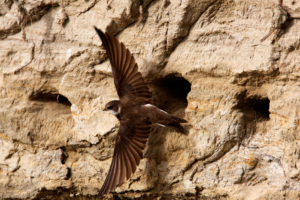
Đelekovec, April 2026 – After a remarkable journey of more than 6,000 kilometres from their wintering grounds in Central Africa, crossing the Sahara Desert and the Mediterranean Sea, Sand Martins (Riparia riparia) have returned to the banks of the Drava River. These tiny birds, weighing no more than 15 grams, are among the first harbingers of spring — and this year they have returned to encouraging news.
The colony at the Libanovec site near Đelekovec grew to a record 1,800 breeding pairs in 2025 — nearly 700 more than the 1,100 pairs recorded in 2018. At a time when sand martin populations across Europe are steadily declining, Đelekovec is becoming a powerful example of how nature can recover when rivers are given space to flow freely.
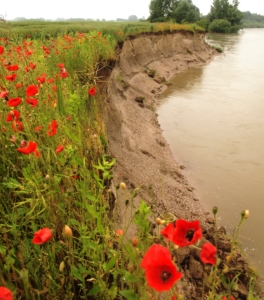
Photo Zdenko Kereša
Sand martins depend on steep riverbanks formed by natural erosion. When riverbanks are artificially reinforced or rivers lose their natural dynamics, sand martins lose their nesting sites — and many other species disappear with them. Within the UNESCO Five-Country Mura–Drava–Danube Biosphere Reserve, sand martin populations are declining as natural riverbanks disappear. The Libanovec colony on the Drava River downstream from Legrad stands out as a rare and important conservation success story and is now one of the most significant sand martin habitats in Croatia.
The birds that keep the skies above the Drava clean
The sand martin is Europe’s smallest swallow — measuring just 12 centimetres in length and weighing around 15 grams. Unlike other swallows, it does not build mud nests; instead, it digs nesting burrows up to 70 centimetres deep into steep riverbanks each year. A single sand martin family can consume up to 10,000 insects per day, most of them mosquitoes. Where sand martins nest, rivers are alive and healthy — their presence is one of the most important indicators of a well-preserved river ecosystem.
The Sand Martin is a strictly protected species under the Croatian Nature Protection Act (Official Gazette 80/13, 5/18, 14/19, 127/19, 155/23), the Ordinance on Strictly Protected Species (Official Gazette 144/13 and 73/16), the EU Birds Directive (Annex I), as well as the Bern Convention and the Bonn Convention.
Đelekovec: a community protecting its river

Photo Marko Lorenzo Blaslov
Declared Croatia’s first Sand Martin Village in 2024, Đelekovec has become an important reference point for the protection of this species in the region. The success of the Libanovec colony is the result of years of cooperation between the Municipality of Đelekovec, the Puhar family farm, Hrvatske vode, and WWF Austria — a partnership that shows nature conservation can coexist with farming and everyday community life.
“I am proud of this achievement in protecting our natural heritage along the Drava River. The return of the sand martins shows how much we can accomplish when a community protects its river and the nature it lives alongside.”
— Lara Samošćanec Kiš, Mayor of the Municipality of Đelekovec

Lara Samošćanec Kiš, Mayor of the Municipality of Đelekovec and Mrs. Puhar, Family farm Puhar, Photo Marko Horvat
Tanja Nikowitz, conservation expert at WWF Austria, added:
“We are eager to see whether this season will bring another record and how many breeding pairs will stay along the banks of the Drava this year. Đelekovec has shown that a local community can make a real difference in protecting natural values, and it stands as an important example for other communities within the UNESCO Five-Country Mura–Drava–Danube Biosphere Reserve. We hope that other municipalities along the Drava River will follow this example of good practice.”

Tanja Nikowitz, Photo Marko Horvat
How to help sand martins during the nesting season
The DRAVA LIFE project team and WWF Austria invite all visitors to the Drava River to respect the peace of steep sandy riverbanks during the nesting season, from April to July. Disturbance to the colony can cause birds to abandon their nests and may result in the loss of chicks.
Every visitor can help by following a few simple guidelines:
- Do not approach steep sandy riverbanks or climb and drive on them
- Observe the birds from a distance
- Keep drones, quad bikes, and off-lead dogs away from nesting colonies
At the Stara Drava Varaždin (C.2) site, works continue on the restoration of the side channel, which was designed and developed as part of the DRAVA LIFE – Integrated River Management project.
Vegetation and tree clearing along the route of the future channel, as well as on the area designated for depositing excavated sediment, has been completed.
C5, HV
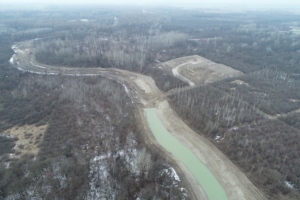
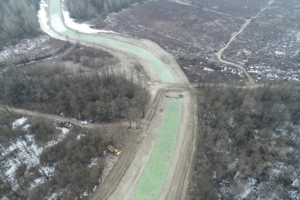
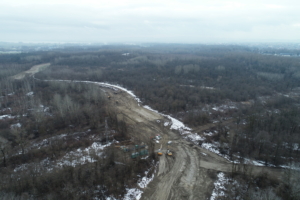
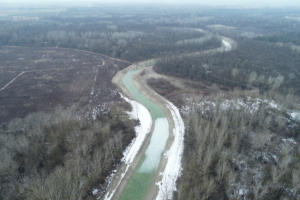
After a brief pause caused by a snow episode, snowmelt, and increased precipitation last week, mechanical excavation has resumed. Works have currently progressed up to cross-section number 21, representing about 40% of the total planned channel length.
Excavation is being carried out in accordance with the project documentation, at elevation levels between 166.6 and 167.8 meters above sea level, designed for a water level with a 95% duration, with slope gradients of 1:2 and 1:4, which are flattened on the convex sides.
The remaining phases of the intervention, currently in the planning stage, will be innovative and based on the principles of Nature-based Solutions (NBS). This approach utilizes the river’s natural processes instead of traditional technical solutions. Such a method will be applied for the first time in Croatia on a river area of this complexity.
The completion of excavation works will depend on future hydrological and meteorological conditions, and the public will be timely informed about the progress of the next phases.
The latest drone footage from the site already provides a clear view of the scope of the intervention and the future appearance of the restored Stara Drava side channel.
Representatives of the DRAVA LIFE – Integrated River Management and LIFE RESTORE for MDD projects carried out a joint field visit to the restoration works at the “Stara Drava Varaždin (C.2)” side channel, one of the key river restoration measures along the Croatian stretch of the Drava River.
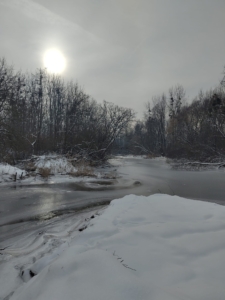
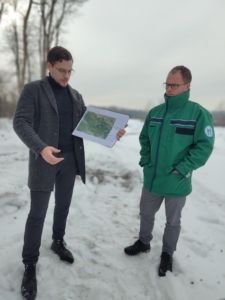
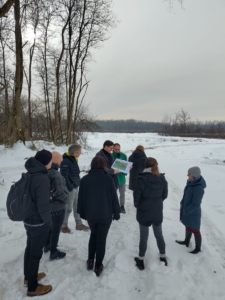
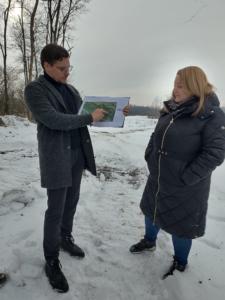
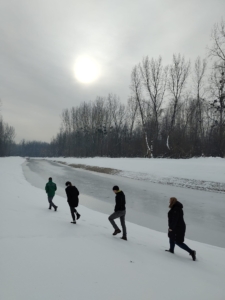
The intervention includes the restoration of a 2.56 km long side channel and improvements to river flow and retention capacity in the City of Varaždin area. The technical solution was developed during the DRAVA LIFE project (2015–2024), while construction is implemented by Croatian Waters, with a total investment value of EUR 1.67 million.
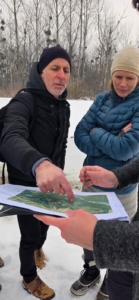
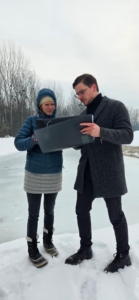
The restoration will enhance river connectivity, improve habitats for aquatic and floodplain species, and contribute to increased flood safety. The visit highlighted the importance of cooperation and knowledge exchange between LIFE projects working towards resilient and naturally functioning river systems.
C2_MP
C2 project
DRAVA LIFE – Integrated River Management has achieved outstanding recognition at the Project Management Awards 2025 in Croatia, one of the country’s most prestigious national competitions aligned with the standards of the International Project Management Association (IPMA).
The project was awarded 1st place in the category “Best Medium-Sized Project”, while the project manager received 1st place in the category “Best Young Project Manager”.
Implemented under the EU LIFE Programme (LIFE14 NAT/HR/000115), DRAVA LIFE is the largest river restoration project ever implemented in Croatia. The Evaluation Committee recognised the project for its excellence in governance, long-term impact, effective stakeholder engagement, and the delivery of measurable and lasting results.
In addition, DRAVA LIFE was selected among the top three finalists in the newly established category “Best Project for Contribution to Sustainability”, introduced in 2025. This recognition further confirms the project’s long-term relevance and its significant added value at the European Union level.
We extend our sincere gratitude to the entire project team, partners, and local communities along the Drava River for their dedication and collaboration. Project activities continue through After-LIFE actions and new EU-level initiatives, in close cooperation with CINEA – the European Climate, Infrastructure and Environment Executive Agency.
Our thanks also go to IPMA Hrvatska – Croatian Association for Project Management, IPMA Young Crew Croatia, and the Evaluation Committee for this valuable recognition.



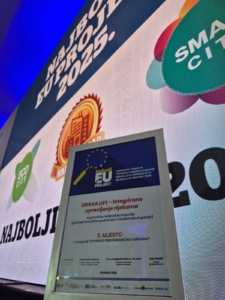
The DRAVA LIFE project – Integrated River Management – won 3rd place in this year’s competition for the Best County EU Project in Croatia, in the category Contribution to Cross-Border Cooperation.
The award was presented at the official ceremony for Best City and Best EU Project, organised in cooperation with Jutarnji list and the Croatian County Association. Koprivnica-Križevci County was recognised for its outstanding contribution to cross-border cooperation through the implementation of the DRAVA LIFE project.
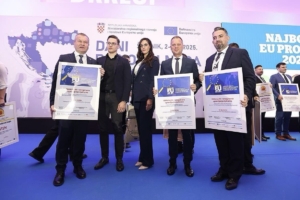
The ceremony took place on 3 December 2025 in Šibenik, attended by the Prime Minister, representatives of ministries, members of Parliament, counties, cities, municipalities, institutions, and other distinguished guests.
This recognition confirms years of dedicated work on the restoration of the Drava River, the strengthening of cross-border cooperation, and the connection of institutions across the three counties covered by the project: Varaždin County, Koprivnica-Križevci County, and Virovitica-Podravina County.
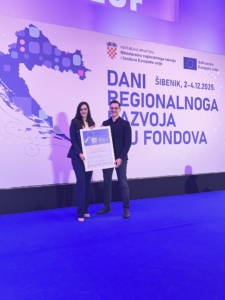
Foto Hrvatske vode
On behalf of the DRAVA LIFE team, the award was received by representatives of Croatian Waters – Water Management Department for the Mura and Upper Drava in Varaždin, the project’s lead partner and coordinating institution.
Other project partners include the Association for Nature and Environmental Protection Zeleni Osijek, public institutions managing protected natural areas in Koprivnica-Križevci, Virovitica-Podravina and Varaždin counties, and WWF Austria.
Preparatory works nearing completion; excavation expected to begin in 10–14 days
At the Stara Drava Varaždin site, located in the left-bank inundation area (rkm 289–292), preparatory works are entering their final phase: larger trees have been removed from the future side-arm channel, access roads have been arranged, and thanks to the low water level of the Drava and stable, dry weather, work has been carried out daily.
The start of the main earthworks (sediment excavation) is expected in 10–14 days.

Areal View
What are we doing and why?
-
Opening and stabilising the inflow into the side arm to re-establish water flow.
-
Excavating a new and widening/deepening the existing channel (left bank) along a length of approx. 2.56 km, with an average bed width of ~13 m.
-
Removing part of the river sill (right bank) that obstructs the natural flow, in order to direct water into the side arm during higher water levels.
-
Sediment (estimated ~148,000 m³) will be deposited along the banks/inundation area and shaped to fit the landscape; if needed, it may also be used as material for dike reconstruction, with prior approval from the competent Ministry.
Expected positive impacts
-
Revitalised hydromorphology: refreshed water in the side arm, a more natural flow regime, and stimulated erosional processes.
-
Creation of new habitats: gravel bars, steep and muddy banks that will benefit fish, amphibians, and birds.
-
Ecological benefits: improved conditions in floodplain forests through raised groundwater levels and increased biodiversity.
-
Community benefits: a more orderly river area and contribution to flood-risk reduction through increased retention capacity.
Route of the future meandering channel
The latest drone photos already clearly show the emerging shape of the future side arm and the progress made in preparing the construction site.
The intervention is being carried out by Hrvatske vode (Croatian Waters) in cooperation with the relevant institutions and the local community. The project concept was developed within the DRAVA LIFE project. All works are carried out in compliance with environmental protection requirements and under expert supervision.
Representatives of the EU project DRAVA LIFE – Integrated River Management, implemented by Croatian Waters, participated in the international event LIFE Platform Meeting – Focus on Water Resilience Strategy, held on 14–15 October 2025 in Brussels and organised by CINEA (European Commission).
The meeting brought together leaders of 39 LIFE projects from 21 EU Member States, with the aim of exchanging experiences and showcasing solutions for implementing River Basin Management Plans (RBMPs) across Europe, with a strong focus on water supply resilience and sustainable water resources management.
During the panel discussions and thematic workshops (Digitalisation & Innovation; Nature-Based Solutions/Nature Restoration), the DRAVA LIFE project presented its contribution to the application of digital tools for river restoration monitoring and planning – including UAV (drone) and satellite imagery, GIS analyses, and the development of a digital database supporting the implementation of the national RBMP and the new European Water Resilience Strategy. The project was also featured in the poster session.
 DRAVA LIFE has been a pioneering example of integrated river management in Croatia and the wider region.
The project achieved numerous results, including:
🔹 acquisition of more than 50 ha of private land for river restoration
🔹 construction of the first initial river side arm and removal of water engineering structures disrupting natural flow
🔹 establishment of an Educational Water Centre at the confluence of the Mura and the Drava
🔹 designation of a Sand Martin ambassador village at the pilot site
🔹 publication of a comprehensive monograph on the Drava River
Even after the project’s formal completion, Croatian Waters and its partners continue to actively and responsibly implement activities — demonstrating that DRAVA LIFE remains a living example of good practice and collaboration.
By combining concrete restoration measures, digital monitoring, and long-term stewardship, DRAVA LIFE shows how European directives (Water, Floods, Habitats, Birds) can be translated into real results on the ground.
More about the event:
LIFE Platform Meeting – Focus on Water Resilience Strategy
LIFE: offering strategic solutions for Europe’s beleaguered river basins