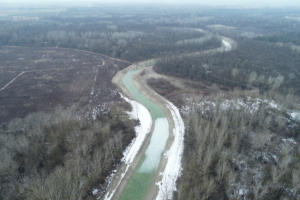
At the Stara Drava Varaždin (C.2) site, works continue on the restoration of the side channel, which was designed and developed as part of the DRAVA LIFE – Integrated River Management project.
Vegetation and tree clearing along the route of the future channel, as well as on the area designated for depositing excavated sediment, has been completed.
C5, HV
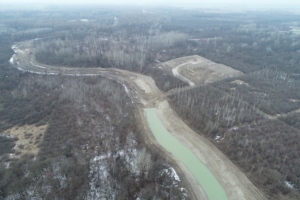
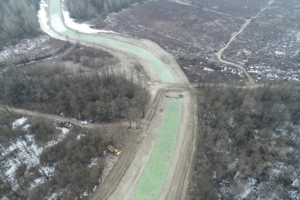
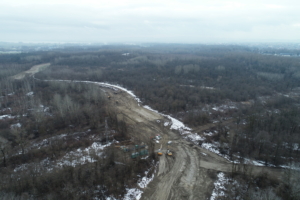
After a brief pause caused by a snow episode, snowmelt, and increased precipitation last week, mechanical excavation has resumed. Works have currently progressed up to cross-section number 21, representing about 40% of the total planned channel length.
Excavation is being carried out in accordance with the project documentation, at elevation levels between 166.6 and 167.8 meters above sea level, designed for a water level with a 95% duration, with slope gradients of 1:2 and 1:4, which are flattened on the convex sides.
The remaining phases of the intervention, currently in the planning stage, will be innovative and based on the principles of Nature-based Solutions (NBS). This approach utilizes the river’s natural processes instead of traditional technical solutions. Such a method will be applied for the first time in Croatia on a river area of this complexity.
The completion of excavation works will depend on future hydrological and meteorological conditions, and the public will be timely informed about the progress of the next phases.
The latest drone footage from the site already provides a clear view of the scope of the intervention and the future appearance of the restored Stara Drava side channel.
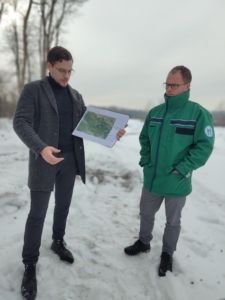
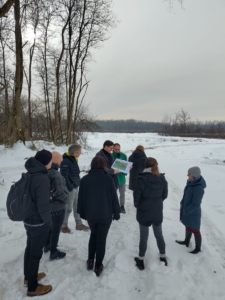
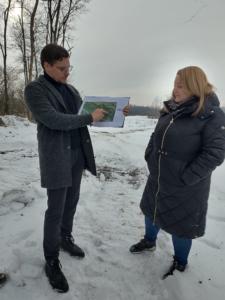
Representatives of the DRAVA LIFE – Integrated River Management and LIFE RESTORE for MDD projects carried out a joint field visit to the restoration works at the “Stara Drava Varaždin (C.2)” side channel, one of the key river restoration measures along the Croatian stretch of the Drava River.
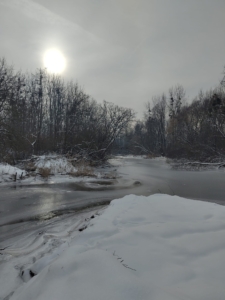
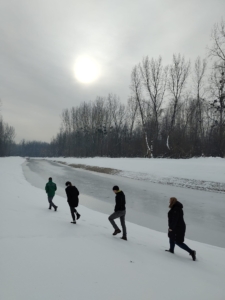
The intervention includes the restoration of a 2.56 km long side channel and improvements to river flow and retention capacity in the City of Varaždin area. The technical solution was developed during the DRAVA LIFE project (2015–2024), while construction is implemented by Croatian Waters, with a total investment value of EUR 1.67 million.
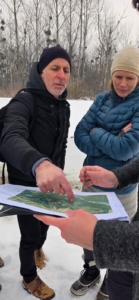
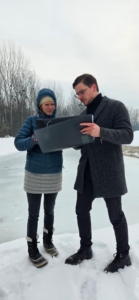
The restoration will enhance river connectivity, improve habitats for aquatic and floodplain species, and contribute to increased flood safety. The visit highlighted the importance of cooperation and knowledge exchange between LIFE projects working towards resilient and naturally functioning river systems.
C2_MP
C2 project
DRAVA LIFE – Integrated River Management has achieved outstanding recognition at the Project Management Awards 2025 in Croatia, one of the country’s most prestigious national competitions aligned with the standards of the International Project Management Association (IPMA).
The project was awarded 1st place in the category “Best Medium-Sized Project”, while the project manager received 1st place in the category “Best Young Project Manager”.
Implemented under the EU LIFE Programme (LIFE14 NAT/HR/000115), DRAVA LIFE is the largest river restoration project ever implemented in Croatia. The Evaluation Committee recognised the project for its excellence in governance, long-term impact, effective stakeholder engagement, and the delivery of measurable and lasting results.
In addition, DRAVA LIFE was selected among the top three finalists in the newly established category “Best Project for Contribution to Sustainability”, introduced in 2025. This recognition further confirms the project’s long-term relevance and its significant added value at the European Union level.
We extend our sincere gratitude to the entire project team, partners, and local communities along the Drava River for their dedication and collaboration. Project activities continue through After-LIFE actions and new EU-level initiatives, in close cooperation with CINEA – the European Climate, Infrastructure and Environment Executive Agency.
Our thanks also go to IPMA Hrvatska – Croatian Association for Project Management, IPMA Young Crew Croatia, and the Evaluation Committee for this valuable recognition.



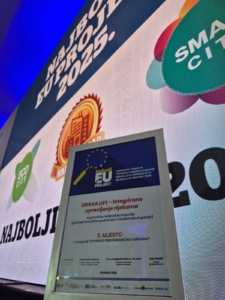
The DRAVA LIFE project – Integrated River Management – won 3rd place in this year’s competition for the Best County EU Project in Croatia, in the category Contribution to Cross-Border Cooperation.
The award was presented at the official ceremony for Best City and Best EU Project, organised in cooperation with Jutarnji list and the Croatian County Association. Koprivnica-Križevci County was recognised for its outstanding contribution to cross-border cooperation through the implementation of the DRAVA LIFE project.
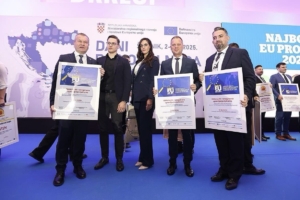
The ceremony took place on 3 December 2025 in Šibenik, attended by the Prime Minister, representatives of ministries, members of Parliament, counties, cities, municipalities, institutions, and other distinguished guests.
This recognition confirms years of dedicated work on the restoration of the Drava River, the strengthening of cross-border cooperation, and the connection of institutions across the three counties covered by the project: Varaždin County, Koprivnica-Križevci County, and Virovitica-Podravina County.
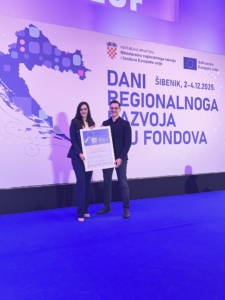
Foto Hrvatske vode
On behalf of the DRAVA LIFE team, the award was received by representatives of Croatian Waters – Water Management Department for the Mura and Upper Drava in Varaždin, the project’s lead partner and coordinating institution.
Other project partners include the Association for Nature and Environmental Protection Zeleni Osijek, public institutions managing protected natural areas in Koprivnica-Križevci, Virovitica-Podravina and Varaždin counties, and WWF Austria.
Preparatory works nearing completion; excavation expected to begin in 10–14 days
At the Stara Drava Varaždin site, located in the left-bank inundation area (rkm 289–292), preparatory works are entering their final phase: larger trees have been removed from the future side-arm channel, access roads have been arranged, and thanks to the low water level of the Drava and stable, dry weather, work has been carried out daily.
The start of the main earthworks (sediment excavation) is expected in 10–14 days.

Areal View
What are we doing and why?
-
Opening and stabilising the inflow into the side arm to re-establish water flow.
-
Excavating a new and widening/deepening the existing channel (left bank) along a length of approx. 2.56 km, with an average bed width of ~13 m.
-
Removing part of the river sill (right bank) that obstructs the natural flow, in order to direct water into the side arm during higher water levels.
-
Sediment (estimated ~148,000 m³) will be deposited along the banks/inundation area and shaped to fit the landscape; if needed, it may also be used as material for dike reconstruction, with prior approval from the competent Ministry.
Expected positive impacts
-
Revitalised hydromorphology: refreshed water in the side arm, a more natural flow regime, and stimulated erosional processes.
-
Creation of new habitats: gravel bars, steep and muddy banks that will benefit fish, amphibians, and birds.
-
Ecological benefits: improved conditions in floodplain forests through raised groundwater levels and increased biodiversity.
-
Community benefits: a more orderly river area and contribution to flood-risk reduction through increased retention capacity.
Route of the future meandering channel
The latest drone photos already clearly show the emerging shape of the future side arm and the progress made in preparing the construction site.
The intervention is being carried out by Hrvatske vode (Croatian Waters) in cooperation with the relevant institutions and the local community. The project concept was developed within the DRAVA LIFE project. All works are carried out in compliance with environmental protection requirements and under expert supervision.
Representatives of the EU project DRAVA LIFE – Integrated River Management, implemented by Croatian Waters, participated in the international event LIFE Platform Meeting – Focus on Water Resilience Strategy, held on 14–15 October 2025 in Brussels and organised by CINEA (European Commission).
The meeting brought together leaders of 39 LIFE projects from 21 EU Member States, with the aim of exchanging experiences and showcasing solutions for implementing River Basin Management Plans (RBMPs) across Europe, with a strong focus on water supply resilience and sustainable water resources management.
During the panel discussions and thematic workshops (Digitalisation & Innovation; Nature-Based Solutions/Nature Restoration), the DRAVA LIFE project presented its contribution to the application of digital tools for river restoration monitoring and planning – including UAV (drone) and satellite imagery, GIS analyses, and the development of a digital database supporting the implementation of the national RBMP and the new European Water Resilience Strategy. The project was also featured in the poster session.
 DRAVA LIFE has been a pioneering example of integrated river management in Croatia and the wider region.
The project achieved numerous results, including:
🔹 acquisition of more than 50 ha of private land for river restoration
🔹 construction of the first initial river side arm and removal of water engineering structures disrupting natural flow
🔹 establishment of an Educational Water Centre at the confluence of the Mura and the Drava
🔹 designation of a Sand Martin ambassador village at the pilot site
🔹 publication of a comprehensive monograph on the Drava River
Even after the project’s formal completion, Croatian Waters and its partners continue to actively and responsibly implement activities — demonstrating that DRAVA LIFE remains a living example of good practice and collaboration.
By combining concrete restoration measures, digital monitoring, and long-term stewardship, DRAVA LIFE shows how European directives (Water, Floods, Habitats, Birds) can be translated into real results on the ground.
More about the event:
LIFE Platform Meeting – Focus on Water Resilience Strategy
LIFE: offering strategic solutions for Europe’s beleaguered river basins

DRAVA LIFE, @Marko Lorenzo Blaslov
Đelekovec, October 1, 2025 – This year, the steep Lubenovec riverbank on the Drava River has hosted as many as 1,800 breeding pairs of sand martins (Riparia riparia) – the highest number ever recorded in this part of the Drava.
Last year, Đelekovec was declared the first Sand Martin Village in Croatia, in recognition of the community’s long-standing efforts to protect this species. The steep sandy bank of Lubenovec has been attracting hundreds of breeding pairs for years, but this season the number reached a historic record.
This remarkable success is the result of cooperation between the Municipality of Đelekovec, the Puhar Family Farm, Croatian Waters, and WWF Austria, who together found a way to align agriculture with the preservation of natural riverbanks. The result is the creation of ideal nesting conditions for sand martins.

Why are sand martins important?
Sand martins are an important indicator of river ecosystem health and highly effective natural insect hunters – during the breeding season, a single bird can eat thousands of mosquitoes per day. Their presence contributes to biodiversity and natural insect control along the Drava.
In 2018, 1,100 pairs were recorded at the Lubenovec site, while this year the number increased by 700 pairs. This growth is significant for the survival of the species and gives hope for its recovery.
This positive result in Đelekovec contrasts with regional and global trends showing a decline in sand martin populations. Globally, the species is decreasing due to the loss of natural, dynamic river habitats such as steep sandy banks, which sand martins use to dig their tunnels up to 70 cm long.
For this reason, protecting the Lubenovec riverbank and similar habitats is extremely important, while legal protection of the species remains key to its long-term survival.
Support from the local community is essential
This year’s Sand Martin Day, held on June 9, brought together residents, visitors, and researchers in educational workshops organized by the Vendi Association. The Đelekovec Primary School dedicated the entire school year to studying sand martins, integrating the topic into nearly all school subjects.
“I’m proud of this success in preserving our natural heritage along the Drava. The return of sand martins shows the power of awareness and dedication within our community. I invite other municipalities to join us in similar initiatives,” said Lara Samošćanec Kiš, Mayor of Đelekovec.
“These birds are a sign of a healthy river. The successful colony in Đelekovec shows that when we give space back to the river and its banks, nature restores itself,” said Arno Mohl, nature conservation expert from WWF Austria. “Seeing 1,800 pairs today is proof that practical conservation measures work. Restoring river dynamics, improving habitats, and raising awareness benefit both nature and people.”
Data on this year’s number of breeding pairs were collected by ornithologists Ivan Grlica and Ivan Darko Grlica.
On Tuesday, 23 September 2025, International Drava River Day will be celebrated at the Educational Water Centre (EVC) in Legrad (Ulica Petefi Šandora 36).
The event is organized by Hrvatske vode and the Public Institutions for the Management of Protected Natural Areas of Koprivnica-Križevci County and Varaždin County. The program will include educational lectures, field workshops for primary school students, and the signing of a Cooperation Agreement with Braća Radić Primary School in Koprivnica and Sveti Đurđ Primary School.
The educational part will cover three thematic areas:
-
the role of Hrvatske vode in river management and flood protection,
-
the importance of biodiversity and the preservation of natural values,
-
education and sustainable development in protected areas.
The field program will offer students practical workshops on river habitat restoration, identification of invasive species, birdwatching, the role of forest ecosystems, and legends connected to the Drava River.
The aim of the celebration is to bring young people closer to the importance of preserving nature and rivers, and to encourage them to actively participate in environmental protection. The Educational Water Centre, established through the DRAVA LIFE project, is a unique place in Croatia that connects education, nature, and the community right at the confluence of the Drava and Mura rivers.
Na lijevoj obali rijeke Drave u Varaždinu (rkm 289,3–292) nastavljaju se radovi obnove rukavca u sklopu EU projekta DRAVA LIFE (Obnova rukavca i proširenje korita rijeke Drave). Nositelj i investitor projekta su Hrvatske vode, Vodnogospodarski odjel za Muru i gornju Dravu.

Trenutni radovi:
-
Pripremni radovi uključuju sječu stabala i uklanjanje sitnog raslinja (do 10 cm) duž trase rukavca, odlagališta iskopanog materijala i pristupnih puteva.
-
Predviđeni radovi obuhvaćaju otvaranje ulaza u rukavac, iskop inicijalnog kanala te proširenje i produbljenje postojećeg neprotočnog dijela.
-
Proširit će se i glavno korito Drave uklanjanjem vegetacije i dijela riječnog praga.
Podaci o rukavcu:
-
Dužina: 2,56 km
-
Prosječna širina korita: 13 m
-
Planirani iskop: oko 148.000 m³ sedimenta
-
Vrijednost radova: 1,67 milijuna eura s PDV-om
Glavna svrha zahvata je ponovno uspostavljanje prirodne protočnosti rukavca i obnova morfološke dinamike rijeke Drave. Ovim projektom omogućit će se osvježavanje poplavnog (inundacijskog) područja, stvaranje novih riječnih staništa, sprudova i obalnih erozija, čime se doprinosi očuvanju i povećanju bioraznolikosti. Vrijednost radova procijenjena je na 1,67 milijuna eura s PDV-om, a radovi se provode uz koordinaciju s nadležnim tijelima (Javna ustanova “PRIRODA Varaždinske županije”, Hrvatske šume, Ministarstvo zaštite okoliša i zelene tranzicije, lokalne zajednice i dr.) i uz primjenu svih mjera zaštite okoliša.
Projekt predstavlja važan korak u obnovi rijeke Drave u Hrvatskoj i široj regiji, a zbog blizine urbanog područja očekujemo i pojačani interes građana za boravkom uz rijeku uz odgovorno očuvanje i korištenje ekosustava rijeke.
Radovi se provode u suradnji s nadležnim tijelima i uz primjenu svih mjera zaštite okoliša. Zbog blizine urbanog područja, građani se mole za oprez i razumijevanje. Ovaj projekt dugoročno doprinosi očuvanju rijeke, smanjenju rizika od poplava i poboljšanju prirodnog okoliša.