
Stara Drava near Varaždin Breathes Again: New Side Channel Opened
Water is flowing again in the restored “Stara Drava Varaždin (C.2)” side channel — Varaždin has gained its first major flowing side channel and a new natural haven on the edge of the city
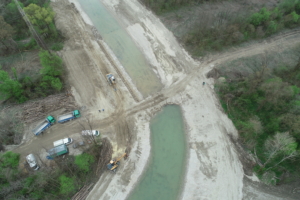
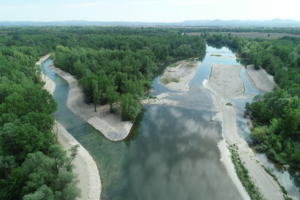
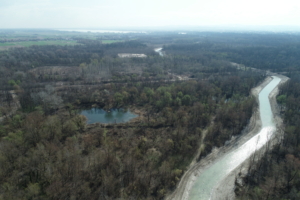
Varaždin, 3 May 2026 — In the area of the City of Varaždin, downstream of “Cirkovečka” and upstream of the tip of the Drava basins, the new side channel “Stara Drava Varaždin (C.2)” has been opened. This is one of the most significant river restoration works on the Drava in recent times, developed through the award-winning and internationally recognised European project “DRAVA LIFE – Integrated River Management”. Varaždin has thereby gained a new natural haven along the Drava, while also improving its flood protection.
The value of the works is approximately 1.7 million euros including VAT, carried out by Hrvatske vode (Croatian Waters) through its regular maintenance programme with financial support from the Recovery and Resilience Facility. This is the result of an almost decade-long process, which included environmental procedures, public consultations, cross-border consultations and cooperation, the preparation of conceptual and detailed designs, and securing financing. Hrvatske vode, the Water Management Department (WMD) for the Mura and Upper Drava, carried out the works despite complex procedures, rising costs and demanding implementation, with the aim of restoring the natural processes of the Drava and creating a safer, more valuable and higher-quality riverside space for Varaždin. The former side channel had for years been cut off from the main river, with water entering mainly from the downstream side and only during higher water levels. Due to the very low flow (biological minimum) in Stara Drava, combined with sediment deposition and vegetation overgrowth, water no longer entered in sufficient quantities to maintain natural dynamics. The consequences were visible across the wider area: groundwater levels declined, riparian forests were affected by succession, the diversity of river habitats decreased, and the main Drava channel was subjected to increasing hydraulic pressure.
Why was vegetation removed?
The removal of vegetation, which was the most visible part of the works, was carried out exclusively along the route of the side channel and in the main Drava channel, opposite the Memorial Cross in the Drava Forest, where vegetation had over decades narrowed the river’s flow cross-section and encroached on former gravel bars and open banks. As Hrvatske vode emphasise, this was not forest exploitation, but rather the restoration of space that historically belonged to the river, alongside a reduction in hydraulic resistance and water levels during high flows, thereby alleviating pressure on the flood defence system, the right bank of the Drava, and existing infrastructure in the Varaždin area. Works being carried out in parallel in the Drava park-forest through the “InterACT Green” project are not part of the “Stara Drava Varaždin (C.2)” works, but a separate project for the improvement and revitalisation of selected parts of the park-forest.
New habitats for protected species
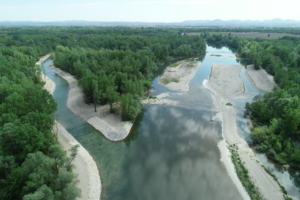
A particular value of this type of river restoration work lies in the creation of new habitats for strictly protected and target river species — birds (little ringed plover, kingfisher, great white egret, black stork), fish (asp) and mammals (otter). Through the shaping of steep sandy-silty banks within the side channel itself and along the left bank of the Drava, favourable conditions have been created for the sand martin (Riparia riparia), a swallow species that through DRAVA LIFE has become a symbol of a clean and dynamic Drava on the steep right bank at Libanovec near Đelekovec. The open gravel and sand bars created by vegetation removal will also benefit the little tern (Sternula albifrons), a species that requires quiet, sparsely vegetated river habitats inaccessible to people for nesting. It is also encouraging that the German tamarisk (Myricaria germanica), a critically endangered riparian plant that the DRAVA LIFE project team has been working for years to reintroduce to the natural habitats of the Drava, has taken hold on the restored Otok Virje (C.1) side channel.
Following the opening of the side channel, the entire area between the channel and the Drava, covering approximately 100 hectares, becomes significantly quieter and more suitable for wildlife. Crossing the side channel is no longer intended, and any crossing is possible solely at one’s own risk due to the possibility of increased flow through the Varaždin hydropower plant dam. The use of quad bikes, motorcycles and other motor vehicles, as well as the construction of new illegal structures in the wider floodplain area, will be strictly prohibited and monitored.
“This is a special moment for me, because the results of years of work are now visible right here, beside my Varaždin. We have returned part of the space and water to the Drava, and the city has gained a new side channel and natural space ideal for the development of river dynamics and fauna. It is proof that flood safety, nature restoration and a higher-quality riverside space can go hand in hand — if the river is approached thoughtfully and with a long-term perspective.”
— Igor Tošić, project manager, Hrvatske vode (Croatian Waters)
With the opening of the side channel, Varaždin has gained a new natural space and haven along the Drava: a place where water, natural dynamics and living ecosystems reconnect, while flood protection is simultaneously improved.
Photos Hrvatske vode

 MLB
MLB