
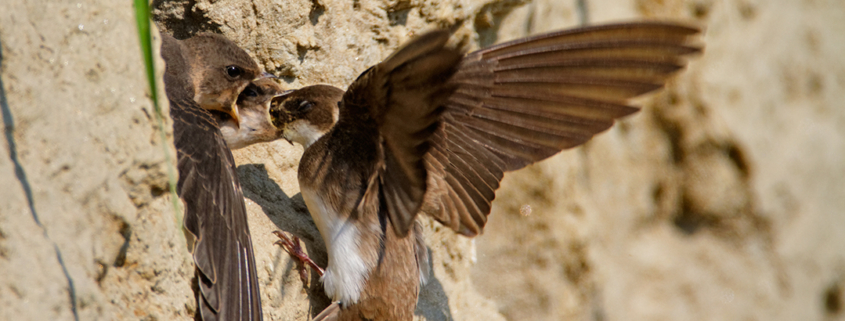
Home again: Sand martins return from Africa to the Drava River
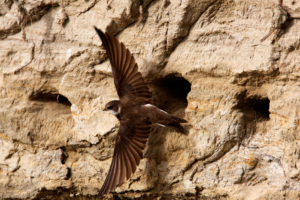
Sand Martin_(c) Goran Safarek
Đelekovec, April 2026 – After a remarkable journey of more than 6,000 kilometres from their wintering grounds in Central Africa, crossing the Sahara Desert and the Mediterranean Sea, Sand Martins (Riparia riparia) have returned to the banks of the Drava River. These tiny birds, weighing no more than 15 grams, are among the first harbingers of spring — and this year they have returned to encouraging news.
The colony at the Libanovec site near Đelekovec grew to a record 1,800 breeding pairs in 2025 — nearly 700 more than the 1,100 pairs recorded in 2018. At a time when sand martin populations across Europe are steadily declining, Đelekovec is becoming a powerful example of how nature can recover when rivers are given space to flow freely.
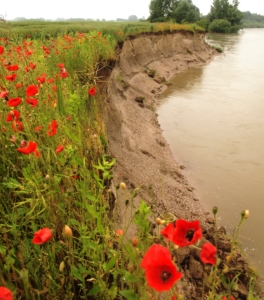
Photo Zdenko Kereša
Sand martins depend on steep riverbanks formed by natural erosion. When riverbanks are artificially reinforced or rivers lose their natural dynamics, sand martins lose their nesting sites — and many other species disappear with them. Within the UNESCO Five-Country Mura–Drava–Danube Biosphere Reserve, sand martin populations are declining as natural riverbanks disappear. The Libanovec colony on the Drava River downstream from Legrad stands out as a rare and important conservation success story and is now one of the most significant sand martin habitats in Croatia.
The birds that keep the skies above the Drava clean
The sand martin is Europe’s smallest swallow — measuring just 12 centimetres in length and weighing around 15 grams. Unlike other swallows, it does not build mud nests; instead, it digs nesting burrows up to 70 centimetres deep into steep riverbanks each year. A single sand martin family can consume up to 10,000 insects per day, most of them mosquitoes. Where sand martins nest, rivers are alive and healthy — their presence is one of the most important indicators of a well-preserved river ecosystem.
The Sand Martin is a strictly protected species under the Croatian Nature Protection Act (Official Gazette 80/13, 5/18, 14/19, 127/19, 155/23), the Ordinance on Strictly Protected Species (Official Gazette 144/13 and 73/16), the EU Birds Directive (Annex I), as well as the Bern Convention and the Bonn Convention.
Đelekovec: a community protecting its river

Photo Marko Lorenzo Blaslov
Declared Croatia’s first Sand Martin Village in 2024, Đelekovec has become an important reference point for the protection of this species in the region. The success of the Libanovec colony is the result of years of cooperation between the Municipality of Đelekovec, the Puhar family farm, Hrvatske vode, and WWF Austria — a partnership that shows nature conservation can coexist with farming and everyday community life.
“I am proud of this achievement in protecting our natural heritage along the Drava River. The return of the sand martins shows how much we can accomplish when a community protects its river and the nature it lives alongside.”
— Lara Samošćanec Kiš, Mayor of the Municipality of Đelekovec

Lara Samošćanec Kiš, Mayor of the Municipality of Đelekovec and Mrs. Puhar, Family farm Puhar, Photo Marko Horvat
Tanja Nikowitz, conservation expert at WWF Austria, added:
“We are eager to see whether this season will bring another record and how many breeding pairs will stay along the banks of the Drava this year. Đelekovec has shown that a local community can make a real difference in protecting natural values, and it stands as an important example for other communities within the UNESCO Five-Country Mura–Drava–Danube Biosphere Reserve. We hope that other municipalities along the Drava River will follow this example of good practice.”

Tanja Nikowitz, Photo Marko Horvat
How to help sand martins during the nesting season
The DRAVA LIFE project team and WWF Austria invite all visitors to the Drava River to respect the peace of steep sandy riverbanks during the nesting season, from April to July. Disturbance to the colony can cause birds to abandon their nests and may result in the loss of chicks.
Every visitor can help by following a few simple guidelines:
- Do not approach steep sandy riverbanks or climb and drive on them
- Observe the birds from a distance
- Keep drones, quad bikes, and off-lead dogs away from nesting colonies